


There is a pattern repeated across almost every data team in B2B technology. A business team submits a question. An engineer picks it up, designs a schema, writes transformation logic, wires together a pipeline, tests it, and weeks later delivers a dataset the business team has since worked around with a spreadsheet. The pipeline exists. The insight arrived too late to matter.
The instinctive response is to hire faster, build more pipelines, or introduce a low-code ETL tool to speed up the handoff. None of these interventions address what is actually broken. The workflow itself is inverted.

The pipeline-first trap
The traditional data workflow runs like this: define a business question, design a schema to answer it, build an ETL pipeline to populate that schema, wait for data to accumulate, then examine what the data reveals. Infrastructure precedes understanding.
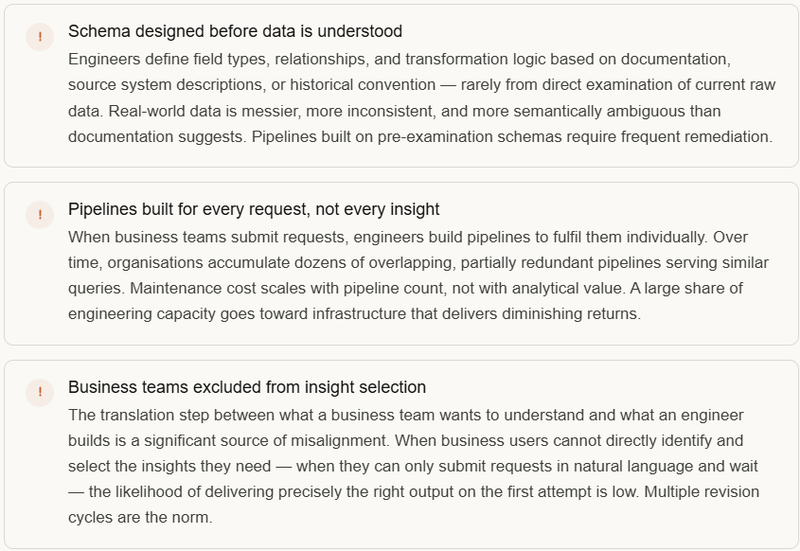
This sequence contains a fundamental problem. Schema design requires assumptions about data structure, completeness, and quality assumptions made before anyone has examined the raw data directly. When those assumptions are wrong (and they frequently are), pipelines break. Transformations fail. Maintenance consumes engineering capacity. The data team spends more time repairing infrastructure than delivering insight.
The numbers reflect this. Data engineering teams report spending 70–80% of their available time on mechanical work, schema redesigns, transformation maintenance, pipeline repairs, leaving only 20–30% for the strategic analytical work the function exists to deliver. This is not a resourcing problem. It is a sequencing problem.
What pipeline-first actually costs
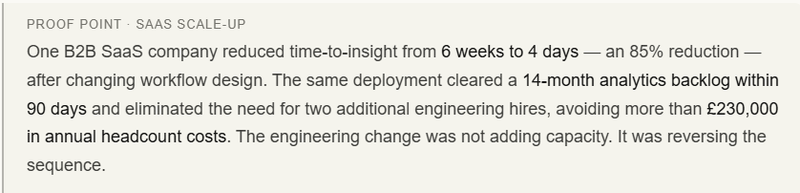
The direct cost of a data engineer in the UK currently exceeds £115,000 annually in total compensation. At 95% capacity utilisation across the profession, adding headcount is both expensive and slow, engineering hires typically take three to six months to reach full productivity.
The indirect cost is harder to measure but larger. When business teams cannot get timely answers, decisions are made without data, or with data that is stale. Product iterations slow. Operational blind spots persist. Investor and board reporting relies on manually assembled figures that carry undisclosed uncertainty. The organisation is data-rich and insight-poor simultaneously.
Insight-first vs pipeline-first
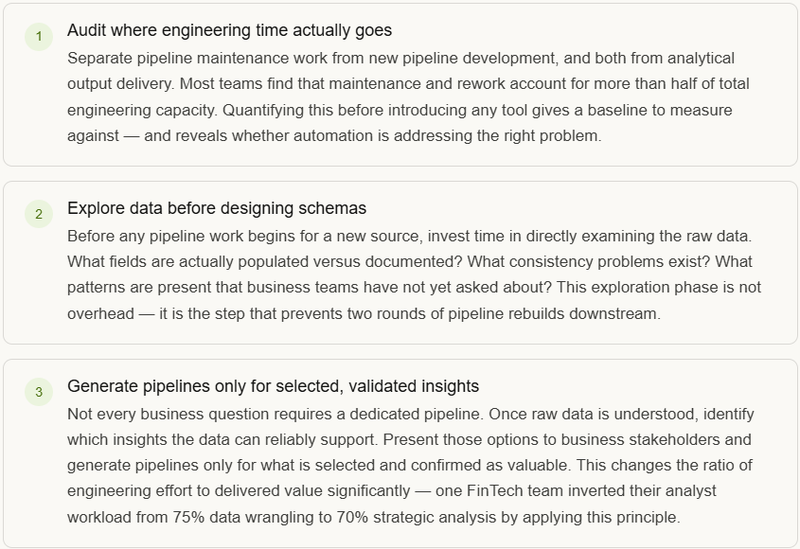
The alternative is not to abandon pipelines. It is to generate them in a different order, after understanding what the data can actually support, not before.
An insight-first workflow runs in the reverse direction. Raw data is explored to understand its structure, quality, and analytical potential. Based on that exploration, specific insights are identified and proposed. Only then are pipelines generated to deliver the selected insights reliably and continuously. Infrastructure follows understanding rather than preceding it.
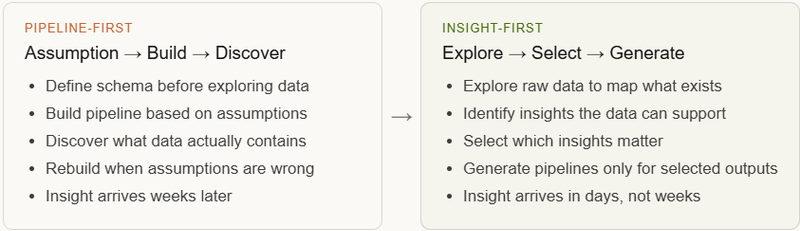
This sequencing change has a concrete effect on pipeline brittleness. When pipelines are generated to deliver specific, validated insights rather than to serve assumed schemas, they break less frequently. The schema reflects data as it actually exists, not as engineers imagined it would exist. Maintenance burden decreases as a direct consequence.
Three things to fix before you automate
Automation applied to a broken workflow produces broken outputs faster. Before reaching for tooling, three design errors are worth addressing explicitly.
A practical sequence for redesigning the workflow
The direction of travel
The market is already moving in this direction regardless of deliberate workflow redesign. 80% of new databases on Databricks are now launched by AI agents, not humans. The ETL market is growing from $7.62 billion in 2024 to a projected $22.86 billion by 2032, driven not by more engineers doing more work manually, but by the substitution of autonomous infrastructure for manual pipeline construction.
The organisations that will extract the most value from that market shift are not those that automate existing broken workflows. They are those that fix the sequencing error first, insight before infrastructure, and then apply automation to an approach that is already sound.
The bottleneck is not engineering capacity. It is the assumption that pipelines should precede insight. Fix that assumption and the capacity problem becomes substantially smaller.
MazeByte context
MazeByte is an autonomous AI platform built around insight-first workflow design. It explores raw data, proposes the insights it can support, and generates end-to-end ETL pipelines only for what is selected, without requiring dedicated data engineering teams. It is designed for SMEs and scale-ups with growing data volumes and limited engineering capacity.